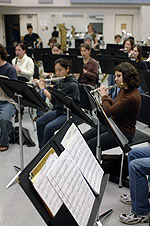
Lewis & Clark’s Department of Music provides a high-quality program with a variety of opportunities for students interested in music. Our faculty of active performers, composers,musicologists/music historians and ethnomusicologists/world music scholars offer their expertise to prepare professionally-oriented students for careers in music. They also have the breadth of perspective to help majors and non-majors integrate music studies into a liberal arts education. With courses and activities designed to enhance understanding and appreciation of music, Lewis & Clark’s music faculty strive to establish music as a perpetually enriching element in the lives of their students.
The Music Major
Majors study musicianship, literature, and theory, and take weekly lessons in their performance area. Ensemble participation further develops skills in group music-making and allows students to broaden their knowledge of repertoire and performance styles.
Students find unusual opportunities to integrate musical studies with activities on Lewis & Clark’s overseas or off-campus study programs. The music department leads a spring-semester program to London every other year. Students have also studied music as part of other overseas programs.
Our innovative music curriculum allows students to personalize their study, working closely with a faculty adviser on their course selections and a senior project. For many students, this work culminates in a performance or composition recital, a musicology or ethnomusicology thesis, or even a hybrid lecture-recital.
Opportunities for nonmajors
All of our music courses, ensembles, and lessons are available to non-majors as well. Introductory offerings include Sound and Sense: Understanding Music, Music Theory Fundamentals, Jazz Appreciation, Workshops in World Music. Upper-level courses are open to any interested student with the appropriate prerequisites. Course sizes range from five students (at the upper level) to 50 students (at the introductory level). Non-majors are also encouraged to participate in the many ensembles on campus.
Examples of student research and independent projects
“Listen Carefully: Humanism and Political Commentary in the Music of John Adams”.
A concert of music for orchestra, band, and chamber ensembles.
A premiere of a student-composed opera.
Examples of positions obtained and graduate schools attended by music alumni
Chairman, Universal Classics Group
Director of Education Programs, San Francisco Symphony
Education and Community Engagement Manager, Oregon Symphony
Assistant Editor, Wieden and Kennedy
Intern, Frank Salomon Associates, Artists management.
Professor of Music, College of William and Mary
Graduate fellowships in Musicology at institutions including UCLA, the University of Michigan, and Princeton University
Music degrees (M.M. and D.MA) at Indiana University, University of British Columbia, University of Iowa, and others
High school band director, college choir director, and private lesson teachers
Graduate student instructorship in Choral Conducting at the University of Michigan
Recent guest artists and performers
Augusta Read Thomas, composer and educator
James Galway, flute performer and instructor
Maria Guinand, Venezuelan choral conductor
Morten Lauridsen, composer
Roomful of Teeth, vocal ensemble
Al-Andalus, Moroccan music group
Third Angle, new music ensemble
Portland Chamber Orchestra, multi-arts orchestra
Resonance Ensemble, vocal ensemble
John O’Conor, Edmund Battersby, Evelyn Brancart, pianists
David Dzubay, composer
W. Francis McBeth, Frank Ticheli, Guy Woolfenden and other well known band composers
Kurt Rosenwinkel, jazz guiarist
Anonymous 4, medieval vocal quartet
Joshua Redman, jazz saxophonist
Cyrus Chestnut, jazz pianist
John Scofield, jazz guitarist
Brave New Works, new music ensemble
Seattle New Music Ensemble
Alexander String Quartet
Duo Solo, flute and piano duo
Music is located in Evans Center on the Undergraduate Campus. MSC: 18